If you’ve spent any time on TikTok since 2024, you already know the shape: a wide-mouth tumbler with a side handle, a flip-up straw lid, and a following so devoted that people have been photographed lining up outside Target before dawn for a new colorway. That’s Stanley — specifically the Quencher, from an American thermos brand founded in 1913 that somehow became the defining object of American girl-lunchbox culture.
Korea, it turns out, wanted the exact same object for one-thirteenth the price. In June 2026, Daiso — the ubiquitous ₩5,000-and-under variety chain — quietly released a “large-capacity handle tumbler” that Korean shoppers immediately clocked as a dead ringer for the Quencher. Within days it had a nickname (다탠리, romanized in the Korean press as “Datanley” — a mash-up of 다이소, Daiso, and 스탠리, Stanley), a run of “품절 대란” headlines, and a sold-out notice on every size and color in Daiso’s online mall. Here’s the story behind Korea’s cheapest viral object of the year, and how to actually get your hands on one.
A quick note on timing: like every Daiso 품절 대란 (sold-out mania), stock on this one comes in waves — sold out online, restocked, sold out again. Treat the details below as a guide to what to look for and where, not a guarantee it’ll be sitting on the shelf the day you walk in.
In this guide:
- What Is the Daiso “Datanley” Tumbler, Exactly?
- Why a ₩5,000 Tumbler Became a Social Media Moment
- Dupe, Not Counterfeit: How Korea Draws the Line
- Colors, Sizes, and Specs
- Where to Buy One in Seoul (2026)
- Tips for Catching a Restock
- Quick Reference
- Frequently Asked Questions
What Is the Daiso “Datanley” Tumbler, Exactly?
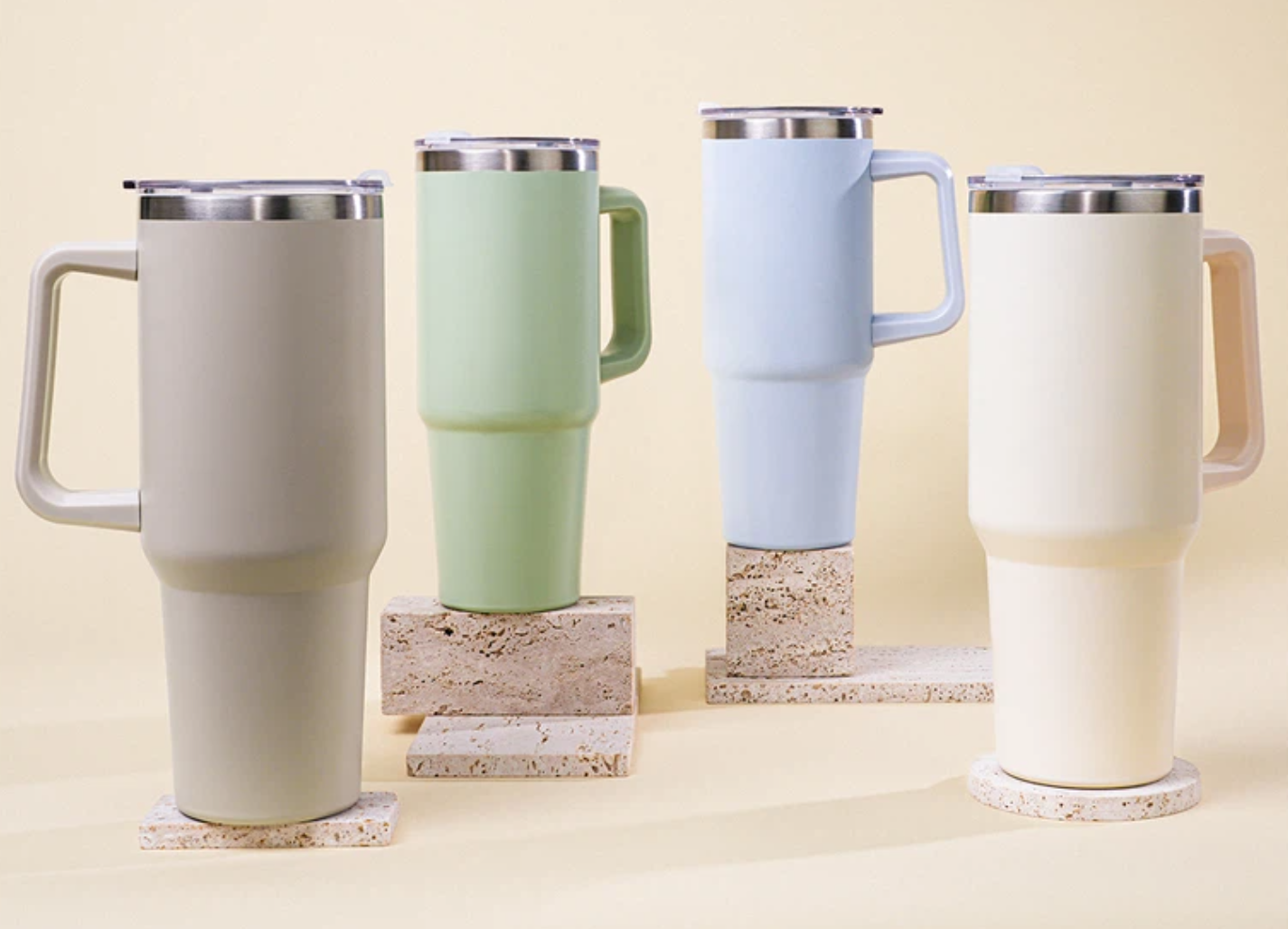
The official product is Daiso’s 대용량 핸들 텀블러 (“large-capacity handle tumbler”) — no branding beyond Daiso’s own, no attempt to use Stanley’s name or logo. What made it a story is simply how closely the silhouette tracks the real thing: a wide stainless-steel body, a moulded carrying handle, and a lid built for a straw, in the same soft, matte pastel finishes Stanley made fashionable.
The price is what turned recognition into a phenomenon. Stanley’s flagship Quencher models — the H2.0 FlowState and the ProTour Flip Straw — sell in Korea for roughly ₩64,000–69,000 in the comparable 1.18L size. Daiso’s version costs ₩5,000, full stop, regardless of size. That’s not a discount or a dupe “close enough” — it’s about a thirteenth of the price for a tumbler that, by most reviews, actually holds its temperature.
Daiso says the tumbler uses a 304 stainless steel interior with a copper-plated coating between the inner and outer walls to cut heat loss, the same basic insulation approach used in far more expensive tumblers. It isn’t a licensed product and carries no Stanley branding anywhere — which matters for the legal and ethical distinction covered below — but the resemblance was close enough that Korean shoppers named it within days of release: 다탠리, dropping the “스” from 스탠리 (Stanley) and bolting on 다(이소). English-language coverage has rendered it as “Datanley.”
Why a ₩5,000 Tumbler Became a Social Media Moment
A few things stacked up at once:
Stanley was already a global meme. The original Quencher went viral in the US across late 2023 and early 2024 — camping-out lines at Target, a widely shared video of one surviving a car fire with the ice still intact, and a resale market for limited colorways that briefly rivalled sneakers. Korean shoppers who’d watched that play out online already understood exactly what a Daiso version of “that cup” meant, with zero explanation needed. That’s rare — most Korean viral products need their own origin story; this one borrowed someone else’s.
It landed in the middle of Korea’s “dupe economy.” 2026 has been the year Korean retail fully embraced the 듀프 (dupe) — a product that copies a pricier item’s look and function without copying its logo, sold openly and often marketed as a dupe rather than hidden as one. Daiso’s Son&Park colour balm (passed around by influencers as a “Chanel lip balm dupe”) and its HEAD-branded running gear both rode the same wave earlier in 2026, and the tumbler slotted straight into a shopping pattern Korean consumers were already primed for. It also fits what Korean trend-watchers call 디토 소비 (“ditto” consumption) — buying what you’ve seen someone else buy or use, rather than shopping from scratch — which is exactly how a tumbler nobody needed became a tumbler everybody wanted the week it appeared on their feed.
It photographs like a before/after. Same genre as Daiso’s other 품절 대란 moments: a fully stocked shelf, then bare pegs and a handwritten restock sign, is its own content format now. A ₩5,000 item that looks like a ₩69,000 one is an easy, instantly legible flex — no context needed for anyone scrolling past.
And the dupe keeps the original in the conversation. Korean coverage in the weeks after launch — the JoongAng Ilbo ran it under the headline “I was debating a Stanley and bought a Datanley” — framed the relationship as closer to symbiosis than pure substitution. A dupe only works if everyone already knows the thing it’s copying, so every Datanley post is also a Stanley mention; one consumer-studies professor quoted in that piece called it a “win-win” structure, with the original’s name recognition growing each time the comparison gets shared.
Dupe, Not Counterfeit: How Korea Draws the Line
It’s worth being precise about what this product is and isn’t, because Korea’s retail press treats the distinction as important. A 듀프 (dupe), from “duplicate,” mimics a pricier product’s shape, color palette, or general vibe — but carries its own maker’s name, not the original brand’s. A 짝퉁, by contrast, is a counterfeit: a fake Stanley logo stamped onto a knockoff, sold to pass as the genuine article.
Daiso’s tumbler is squarely the former. There’s no Stanley branding, no attempt to pass as an authentic Quencher, and no ambiguity at checkout about what you’re buying — Daiso’s own name is on the box. That’s a meaningfully different category from counterfeiting — though not a legal free-for-all: Korean courts have ruled against products that lean too heavily on another brand’s design even without copying its logo, and where “reference” ends is still debated. It’s also a long way from the fake-goods problem that dogs categories like collectible toys, where counterfeit Labubu figures (“Lafufu”) have actually tested positive for carcinogenic materials in Korean customs seizures. Nobody is getting scammed by a ₩5,000 tumbler that was always sold, and always understood, as a ₩5,000 tumbler.
Colors, Sizes, and Specs
| Spec | Details |
|---|---|
| Official name | 대용량 핸들 텀블러 (Large-Capacity Handle Tumbler) |
| Nickname | 다탠리 / “Datanley” (Daiso + Stanley) |
| Price | ₩5,000 — same price for both sizes |
| Sizes | 900mL and 1,200mL |
| Colors | Ivory, Blue, Green, Beige (soft, pastel-leaning tones) |
| Material | Stainless steel interior (304 grade), copper-plated coating between the walls for insulation |
| Lid | Straw-compatible — use it with a straw or drink directly, much like a Stanley Quencher |
| Launched | Early June 2026 |
| Comparable Stanley models | Quencher H2.0 FlowState / ProTour Flip Straw, ₩64,000–69,000 in Korea |
Where to Buy One in Seoul (2026)
The tumbler runs through the same distribution as every other Daiso item — no separate raffle or app-only drop, unlike some of Korea’s hyped collectibles — but stock still concentrates at the chain’s largest stores:
- Myeongdong branches — Daiso’s flagship-density neighbourhood, with several large stores within a few minutes’ walk of each other; the best odds of catching a fresh delivery.
- Hongdae — high foot traffic and a younger shopper base means this is also one of the first areas to sell out, so mornings are your best bet.
- COEX Mall (Gangnam-gu) and the Gangnam Station store (a multi-floor branch about 220m from Exit 11) — large-format stores that tend to carry the fuller color range.
- Daiso Mall app / daisomall.co.kr — restocks post online too, and if your color is sold out the app’s 재입고 알림 (restock alert) feature will tell you when new stock lands, the same tool shoppers used to track Daiso’s HEAD running vest drops earlier this year.
If you’re building a Myeongdong or Hongdae afternoon around Daiso anyway — alongside the K-pharmacy tour or a stop for Korea’s other summer must-haves — checking the tumbler shelf costs you nothing extra even if it comes up empty.
Tips for Catching a Restock
- Set the app alert before you land. The Daiso Mall app lets you follow specific colors and sizes and pings you the moment they’re back — don’t wait until you’re standing in front of an empty shelf to start tracking it.
- Go early, and go to a flagship. Small neighbourhood Daiso branches carry a narrower range and may not stock it; the large multi-floor stores in Myeongdong, Hongdae, and COEX are the better bet.
- Take whichever color is in stock. With four very similar pastel options and identical pricing, holding out for one specific shade is the single biggest reason people leave empty-handed.
- Buy more than one if you find them. At ₩5,000 each, it’s one of the cheapest genuinely useful souvenirs in Seoul — pick up two or three as gifts while the shelf is full, since you may not get a second chance later in your trip.
- Don’t panic if it’s sold out when you visit. Availability varies by store, color, and week, so an empty shelf at one branch doesn’t mean it’s gone everywhere. A backup color, or a different item entirely from the broader Daiso sold-out list, is a perfectly good plan B.
Quick Reference
| What | Details |
|---|---|
| What to ask for / look for | 대용량 핸들 텀블러 (or just “다탠리” if asking staff) |
| Price | ₩5,000 flat, both sizes |
| Best stores | Myeongdong, Hongdae, COEX Mall, Gangnam Station |
| Best time to go | Store opening, weekday mornings |
| How to track restocks | Daiso Mall app → 재입고 알림 (restock alert) |
| Real Stanley price for comparison | ₩64,000–69,000 |
Frequently Asked Questions
Is the Daiso tumbler actually a Stanley product? No. It’s an unaffiliated Daiso product with no Stanley branding, logo, or licensing — a “dupe” in the sense of resembling the shape and function of a Stanley Quencher, not a counterfeit trying to pass as one.
Why is it called “Datanley” or 다탠리? It’s a Korean-language portmanteau of 다이소 (Daiso) and 스탠리 (Stanley) — shoppers coined the nickname within days of the tumbler’s June 2026 release, and it stuck.
Is it actually good, or just cheap? Reception has been positive for the price point — reviewers note real insulation performance from the copper-coated, stainless steel construction, though nobody is claiming it matches Stanley’s build quality one-to-one. At ₩5,000, most buyers treat it as a daily-use backup or an easy gift rather than a permanent replacement for a “real” one.
Where’s the best place to find it as a tourist? Large Daiso branches in Myeongdong, Hongdae, or COEX Mall carry the widest color range when stock is available. Check the Daiso Mall app before you go to see what’s currently available, and set a restock alert for anything that’s sold out.
Is buying a dupe like this frowned upon in Korea? Not at all — 2026 has seen dupe culture go fully mainstream in Korean retail, openly marketed and openly discussed, which is a different social pattern from buying counterfeit goods. Sellers and buyers alike are upfront that it’s a Daiso product inspired by a pricier design, not an attempt to pass it off as the real thing.
What other Daiso items are worth chasing on the same trip? The tumbler is part of a wider 2026 pattern of Daiso items selling out nationwide — see our full guide to Daiso’s sold-out mania for the current list of what else is worth checking for.
Whether or not you already own the ₩69,000 original, a ₩5,000 tumbler with the exact same silhouette is a genuinely funny, genuinely useful thing to bring home from Seoul — assuming you can find one on the shelf. Check the app, hit a flagship store in the morning, and grab whatever color is actually in stock. For more of what’s currently disappearing off Korean shelves and going viral on Korean social media, see Daiso’s broader sold-out mania and what else is trending across Korea right now.